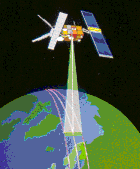
 GOME on board of ERS-2. Credits ESA.The technique used to retrieve total columns of atmospheric trace species such as BrO from GOME and SCIAMACHY measurements is the Differential Optical Absorption Spectroscopy (DOAS). The DOAS technique was first developed in the late seventies for ground-based remote sensing [Platt, 1994, and references therein].
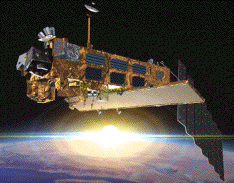 Envisat satellite, artist's impression. Credits ESA/Denmann production.
Since the early nineties, BIRA-IASB has used developed experience in using this technique for ground-based UV-visible remote sensing of atmospheric composition. This experience has been and is applied to the data analysis of GOME and SCIAMACHY data.
The spectral analysis is performed using WinDOAS, a multi-purpose DOAS analysis software developed over the nineties at BIRA-IASB.
This software initially developed for ground-based applications has been thoroughly validated through participation at various intercomparison exercises [Hofmann et al., 1995; Roscoe et al., 1999; Aliwell et al., 2002]. A version of the programme can be obtained by contacting the authors.
An overview of the software is also possible by downloading the Software User Manual (.pdf).
These pages provide you with specific information on the DOAS retrievals from GOME and SCIAMACHY measurements as well as a quick comparison between both.
Acknowledgements
These activities are or have been supported by ESA/ESRIN (TEMIS project), the Belgian Federal Office for Science Policy (BELSPO) and the ESA Prodex programme. Special thanks go to Claus ZEHNER from ESA-ESRIN. The SCIAMACHY research is supported by the SCIAMACHY validation team.
This work would not have been possible without numerous discussions and helpful interaction with other groups involved in the GOME activities, in particular:
- the University of Bremen,
- the University of Heidelberg and
- the Harvard-Smithsonian Center for Astrophysics (SAO).
The ERS-2 GOME operational level-1 product have been processed at DFD/DLR on behalf of ESA.